
Happy Cannonball Day!
wounded, wearied and wandering still

Today is a curious holiday in the Ignatian tradition: We commemorate the date on which St. Ignatius of Loyola was grievously wounded in war.

The story goes like this: On May 20,1521, at the Battle of Pamplona, Ignatius the soldier rallied his fellow Spanish fighters to refuse the offer of surrender made by the superior French forces with which they were engaged in battle. The resulting casualties to the Spanish forces were massive, and Ignatius was carried home to Loyola to recover from injuries sustained by a cannonball blast to the legs. He would stay there for eleven months.
We call this the cannonball moment, though it was less a moment and more an agonizing parade of days and weeks and months rife with painful recovery and reflection. Ignatius did not get knocked down as a soldier and stand up as a saint.
In fact, even if we stretch this idea of a cannonball moment to include the entirety of his convalescence in Loyola—those eleven long bedridden months—we still would not have at the end of it all a tried and true saint. What we’d have is a man with more questions than answers, a man wearied by the world and wounded by human struggle, who had nonetheless decided to stand and muddle onward to see what life yet had in store for him.
A man not so unlike most of us.
The difference, though, was that now Ignatius did all with and for Christ. Crucially, Ignatius gave his imagination over to the God of Surprises, a God whose plans Ignatius could not fully know but in whom he trusted, with whom he desired to labor and create, through whom he knew he would be utterly transformed.
In short, Ignatius’ cannonball moment had broken apart an old way of living, a status quo that had grown claustrophobic and insufficient. The pieces of that old life lay all around him, shards of proverbial glass primed to cut the pilgrim’s bare feet. It was up to him to step forward. It was up to him to chart a new path. It was up to him to risk the unknown and the as-yet unimaginable.
That was where God was calling him to go. It was from the other side of the known and the comfortable that God’s voice beckoned.
In truth, that’s what we commemorate today. Not a wound—though certainly we all have them—nor the dismantling of a broken status quo—though that, too, is something to be applauded. We don’t celebrate the making of a saint—for that’s the work of a life, not a moment—and we don’t commend Ignatius for abandoning a so-called worldly existence, for it is in the world that we encounter the living God.
What we commemorate today, what we embrace in our own stories, is the threshold that a true cannonball moment reveals. These are painful moments, hard moments, moments of challenge and risk and peril. The pieces of an old way of proceeding are littered about our feet—careful! They’re sharp and your feet are bare. How tempting it is to collect them, to wrestle them back together into some coherent shape. How comfortable that might make us feel.
And yet, we know those days are behind us. The status quo will not hold together, and so we set out on adventure—a new adventure—buoyed by the God who desires to surprise us along the way.
But first, we must make that initial move, take that beginning step. And so, what will we do? How will we respond?
Because what we do next is not the whole story; our cannonball moment won’t make of us saints. Rather, what we do next is but one chapter—perhaps one solitary sentence—in our unfolding stories, stories of transformation and love and resurrection and return.
The cannonball is not the story. The cannonball is the catalyst. The story is unfolding all around.
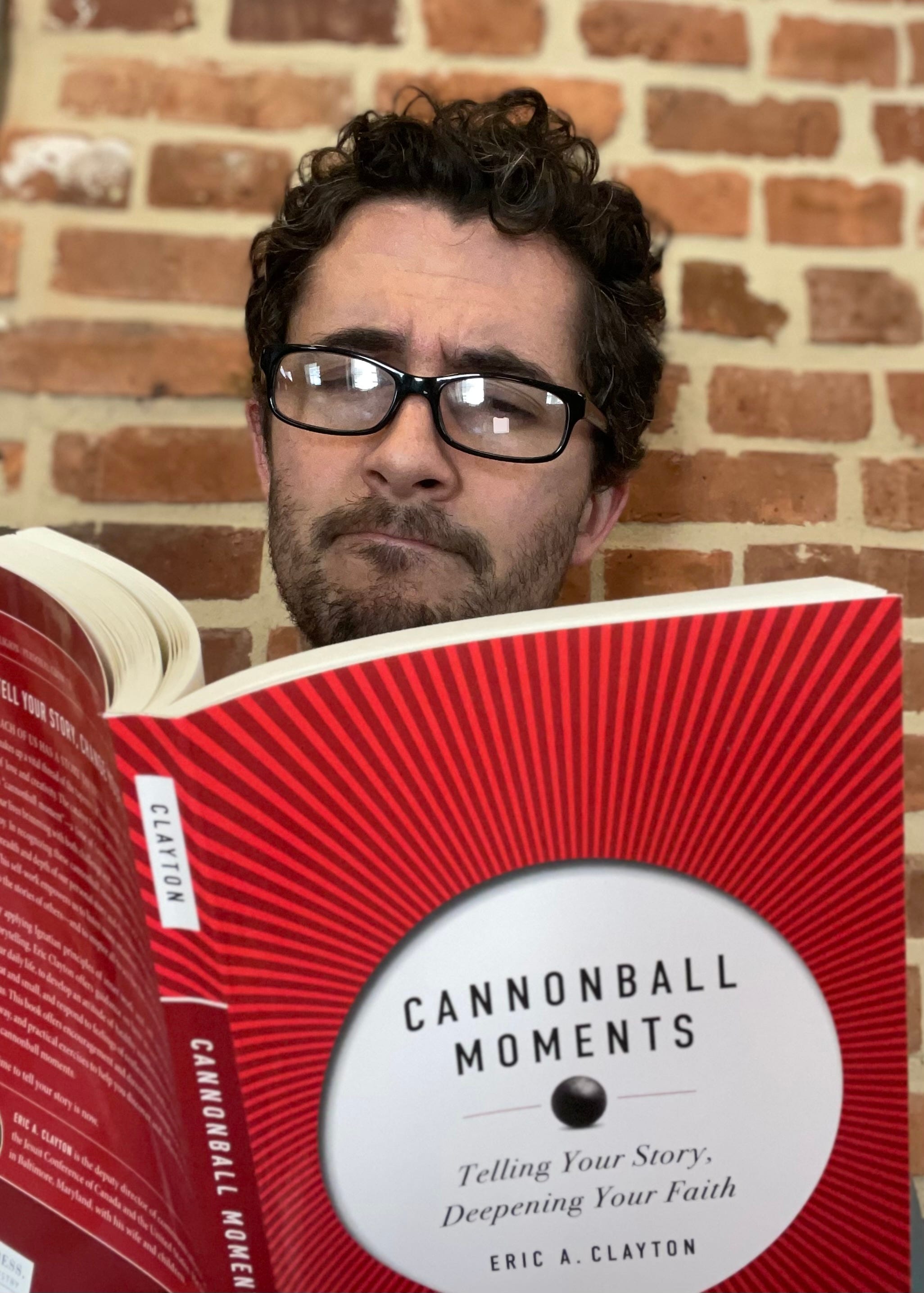
Today is a special day for me because it just so happens to call to mind my very first book, Cannonball Moments: Telling Your Story, Deepening Your Faith. If you haven’t yet, give it a read! Click here to learn more.
Wonderful piece. This is so relatable to my own spiritual journey.
In my case, deep suffering through addiction, mental health struggles, and incarceration forced me into a place where I had no choice but to turn to God. In that surrender, the Spirit entered my heart, and I began my own adventure.
It has been a journey of abandoning old ideas and grounding my life in a new set of ideals. Along the way, God has sent many teachers, experiences, and moments of grace that continue to shape and mold me into the person I have always hoped to become.
This is an exceptional piece, Eric. It’s one thing to observe; it’s another to get philosophical about your observations. This writing exemplifies the best of Eric Clayton, philosopher. Beautifully written and thoroughly thought-out—I hope Ignatius saw it. He’d be pleased.